
Education
Top 5 Bookkeeping Mistakes Businesses Avoid by Outsourcing


Financial chaos rarely announces itself with a bang. It doesn’t arrive like a sudden market crash or a PR scandal. Instead, it’s a slow, quiet erosion of clarity. It starts with a few missing receipts in June and ends with a panicked, sleepless weekend in January as you stare at a bank balance that doesn’t match your spreadsheets.
For many founders, the realization that they’ve lost control happens during a routine conversation, perhaps a vendor asking about an “overdue” invoice you were certain was paid, or a lender requesting a current P&L that you simply cannot produce. When reports become unreliable and reconciliations fall months behind, you aren’t just dealing with an administrative backlog; you are flying your business in a fog. This is precisely why outsourcing bookkeeping services has shifted from a “nice-to-have” cost-saving tactic to a fundamental operational requirement for scaling companies.
This isn’t about simple data entry errors. It’s about the operational disorder that sets in when financial visibility vanishes.
Why Do Bookkeeping Problems Become Business Problems?
We often talk about financial errors as if they exist in a vacuum. In reality, your ledger is the heartbeat of your operations. If the data is wrong, every decision downstream is compromised.
Think about your last major hire. Did you base that salary offer on a “gut feeling” about your bank balance, or on a verified three-month trend of net profit? When you set your pricing for a new contract, did you account for the creeping inflation in your overheads, or were you looking at costs from two quarters ago?
The Concept of Bookkeeping Debt
Much like technical debt in software development, Bookkeeping Debt is the price you pay later for taking shortcuts now. Small inaccuracies, a misclassified expense here, a forgotten VAT entry there accumulate quietly. By the time you need to clean it up for an audit, a loan application, or a sale, the “interest” on that debt is paid in expensive forensic accounting fees and immense personal stress.
Signs your business is already carrying this debt include:
- You are constantly three months behind on your records.
- VAT deadlines feel like an emergency rather than a routine task.
- You have a “gut feeling” you’re profitable, but the bank balance says otherwise.
- Invoices go out late because nobody is quite sure who has already paid.
- Month-end takes three weeks to close instead of three days.
Mistake #1(Falling Behind on Financial Records)
This is the most common point of failure. It usually begins when a founder or a lean finance team becomes overloaded. You tell yourself you’ll “catch up on Sunday,” but Sunday is swallowed by family or more pressing operational fires.
Why the Backlog Happens?
As transaction volume increases, the sheer weight of finance admin grows exponentially. Without a dedicated owner of the bookkeeping workflow, the task is treated as reactive. It becomes something you do when you have to, rather than a proactive habit.
The Hidden Damage
A backlog isn’t just “late paperwork.” It’s a delay in intelligence. If you don’t know your numbers until 45 days after the month ends, you are essentially driving by looking in the rearview mirror. You cannot forecast cash flow if you don’t know your current burn rate. You cannot pivot away from a loss-making product if you won’t see the loss for another two months.
The Emotional Toll: There is a specific kind of low-grade anxiety that comes from having a “dark” financial corner in your business. It’s the fear of checking your accounts because you aren’t sure what you’ll find. Outsourcing bookkeeping services solves this by establishing a dedicated process owner who ensures records are updated in real-time, regardless of how busy the founder gets.
Mistake #2(Poor Reconciliation Practices)
Many business owners look at their bank balance and assume that’s the “truth.” This is a dangerous assumption.
The False Reality of Bank Balances
Bank reconciliation is the process of matching your internal records against your bank statements. It sounds simple, but it’s where the most expensive errors hide. Duplicate transactions, missed subscription cancellations, and disconnected payment gateways (like Stripe or PayPal) can create a massive delta between what you think you have and what is actually available.
Why Do Businesses Stop Trusting Their Numbers?
When a business owner spots even one or two significant errors in their reports, they stop trusting the entire data set. Once trust is gone, the reports become useless. You stop looking at them. You go back to “gut feel” management, which is the fastest way to hit a growth ceiling.
By utilizing professional services, you ensure regular reconciliation cycles. A professional bookkeeper doesn’t just “input” data; they hunt for discrepancies. They ensure that your payroll matches your bank exit, your VAT matches your sales, and your software integrations are actually talking to each other.
Mistake #3(Mixing Operational Chaos with Financial Management)
Here is a hard truth: a bookkeeper cannot fix a broken business process. If your team is “slack-ing” photos of receipts to a random folder, or if invoice approvals are buried in a manager’s overflowing inbox, your bookkeeping will always be a mess.
Bookkeeping is a Systems Problem
Many companies try to solve financial chaos by throwing more hours at it. They hire a part-time admin to “tidy things up.” But without a standardized system, that admin is just reorganizing the chaos.
Growing businesses outgrow DIY systems when:
- Transaction Volume Scales: Moving from 50 to 500 invoices a month requires automation, not just a faster typist.
- Multiple Channels Emerge: Selling on Amazon, Shopify, and via direct invoice requires a complex mapping of sales tax and fees.
- VAT Complexity Increases: Crossing the threshold into different VAT schemes requires precise categorization that an amateur will likely miss.
The value of an outsourced partner isn’t just the labor; it’s the structure. They bring the software integrations (like Xero, Dext, or Hubdoc) and the workflow accountability that forces your team to be disciplined with documentation.
Mistake #4(Making Decisions Using Inaccurate Financial Data)
This is where bookkeeping errors move from the back office to the boardroom. Strategic damage is the most expensive consequence of poor financial management.
Financial Blind Spots
Consider the “Growth Trap.” A business sees revenue climbing 20% month-over-month. They decide to double their marketing spend and hire three new account managers. However, because their bookkeeping is inaccurate, they haven’t noticed that their cost of goods sold (COGS) has also risen, or that their “days sales outstanding” (how long it takes customers to pay) has stretched from 30 to 60 days.
They are growing into bankruptcy because their cash flow is deteriorating while their revenue is rising.
Moving from Reactive to Strategic
Bad bookkeeping turns you into a firefighter. You spend your time reacting to “surprises”: a surprise tax bill, a surprise cash shortfall, a surprise payroll error. Accurate, timely management reporting allows you to be a navigator instead. When you know your margins are shrinking in real-time, you can adjust your pricing before the quarter is a total loss.
Mistake #5(Choosing Cheap Bookkeeping Instead of Reliable Processes)
In the world of finance, “affordable” is often the most expensive word in the dictionary.
The False Economy of Low-Cost Outsourcing
Many businesses fall into the trap of hiring the cheapest freelancer they can find on a global marketplace. While this saves a few hundred pounds a month initially, the hidden costs are staggering.
- Cleanup Costs: We frequently see businesses pay three times their original fee to a professional firm to “undo” the mess created by an unqualified provider.
- Communication Gaps: When your bookkeeper doesn’t understand UK-specific tax nuances or isn’t available during your working hours, the friction slows your business down.
- Lack of Accountability: A freelancer might disappear; an established firm has a reputation and a process to maintain.
What Real Visibility Looks Like?
Quality outsourcing bookkeeping services should increase your visibility, not reduce it. You shouldn’t feel like your data is disappearing into a black hole. A professional partnership provides you with monthly management packs, proactive updates on KPIs, and a clean audit trail that makes your year-end accounting a breeze rather than a battle.
Why Businesses Outsource Before Problems Become Expensive?
Smart founders don’t wait for a crisis to fix their finance function. They view bookkeeping as operational infrastructure, not an administrative chore.
In the UK, the pressure is higher than ever. With the rollout of Making Tax Digital (MTD) and increasingly stringent HMRC compliance, the margin for error has vanished. Penalties for late or inaccurate VAT filings are now automated and aggressive. Furthermore, the current shortage of skilled local finance staff makes hiring in-house an expensive, time-consuming risk.
By outsourcing, you buy back your time and, more importantly, your mental bandwidth. You stop being the “Chief Paperwork Officer” and go back to being the CEO.
Signs a Business Has Outgrown DIY Bookkeeping
How do you know it’s time to move on from your current setup? Look for these red flags:
- The Sunday Scaries: You spend your weekends catching up on bank reconciliations.
- Estimation Management: You make hiring or purchasing decisions based on an “estimate” of your cash rather than a report.
- Stressful Deadlines: Tax dates feel like a looming threat rather than a scheduled event.
- Transaction Velocity: You’ve gone from a few dozen transactions to hundreds, and the spreadsheets are breaking.
- Information Lag: You ask for a profit report and are told it will take “a few days” to pull it together.
What Businesses Gain From Financial Clarity?
When you finally have a clean, professional bookkeeping system, the shift in your business is palpable.
- Confidence: You can speak to investors or lenders with total authority because you know your numbers are bulletproof.
- Predictability: Cash flow forecasting becomes a science rather than a guessing game.
- Scalability: You have the systems in place to handle a 2x or 5x increase in volume without the wheels falling off.
- Profitability Tracking: You finally see which products or clients are actually making you money, and which are just keeping you busy.
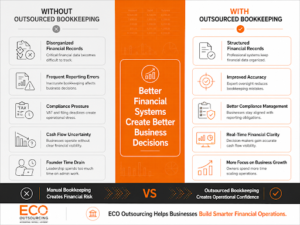
FAQ(Frequently Asked Questions)
How does outsourcing bookkeeping prevent businesses from mixing personal and business expenses?
Mixing personal and business expenses is one of the most common and costly mistakes small business owners make, often triggering HMRC scrutiny and making year-end accounts a nightmare to untangle. An outsourced bookkeeper establishes clear, structured processes from day one that keep personal and business finances completely separate. They flag any ambiguous transactions immediately and ensure every expense is correctly categorised before it creates a compliance problem. This simple discipline alone saves businesses significant time, money, and stress every single year.
How does outsourcing prevent businesses from falling behind on bank reconciliations?
Many business owners allow bank reconciliations to pile up for weeks or months, creating a growing backlog of unmatched transactions that becomes increasingly difficult to resolve. An outsourced bookkeeper performs reconciliations on a regular, systematic basis ensuring your books always reflect your true financial position in real time. Catching discrepancies early means errors, duplicate payments, and fraudulent transactions are identified before they compound into serious problems. Regular reconciliation also means your financial reports are always accurate and reliable when you need them most.
How does outsourcing help businesses avoid missing VAT deadlines and filing errors?
VAT compliance is one of the most stressful aspects of running a small business, with quarterly deadlines, complex rules, and Making Tax Digital requirements all creating significant pressure. An outsourced bookkeeper manages the entire VAT process categorising transactions, preparing returns, and submitting them well ahead of every deadline. They stay updated on all HMRC rule changes ensuring your VAT filings are always accurate, compliant, and on time. The penalties for late or inaccurate VAT submissions make professional oversight one of the most financially protective investments a business can make.
How does outsourcing prevent the costly mistake of poor cash flow management?
Poor cash flow management is one of the primary reasons small businesses fail despite generating healthy revenue. An outsourced bookkeeper maintains real-time accurate records giving you a clear view of exactly how much cash is available, what is owed to you, and what you owe at any given moment. They monitor outstanding invoices, flag overdue payments, and alert you to upcoming financial commitments before they catch you off guard. This level of visibility transforms cash flow from a constant source of anxiety into a confident, controlled process.
How does outsourcing prevent businesses from losing track of receipts and expense records?
Lost receipts and disorganised expense documentation result in missed tax deductions, inaccurate financial reports, and potential HMRC penalties if records cannot be produced during an enquiry. Outsourced bookkeepers implement digital receipt capture systems like Dext or Hubdoc allowing you to photograph and upload receipts instantly from your phone, eliminating paper entirely. Every expense is digitally recorded, correctly categorised, and securely stored in your cloud accounting system the moment it is captured. This systematic approach ensures you never miss a legitimate tax deduction and always have documentation to support your financial records.
Conclusion:
Bookkeeping mistakes are rarely just about the math; they are symptoms of overwhelmed systems and operational gaps. If you find yourself constantly reacting to financial surprises, your current DIY approach has reached its limit.
The businesses that thrive are those that prioritise financial clarity early, recognising that a clear view of the numbers is the only way to steer through the complexities of growth. That is where Eco Outsourcing comes in. From eliminating receipt chaos and preventing VAT errors to real-time bank reconciliations and accurate monthly management reports, their experienced team tackles every bookkeeping mistake at its root before it costs your business time, money, or credibility.
By partnering with Eco Outsourcing, you aren’t just saving time you are building a financial foundation your business can actually scale on.
You May Also Read : Soutaipasu Explained: Meaning, Uses, and Why It’s Gaining Attention
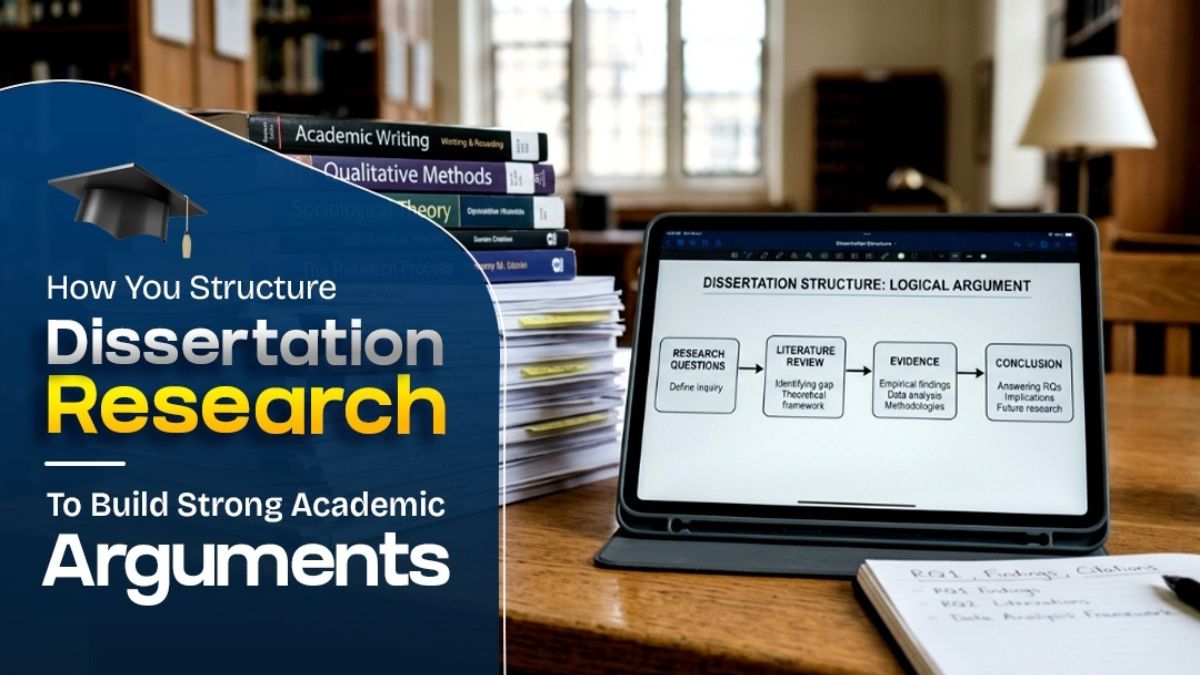
Learning how to structure a dissertation argument is the single skill that separates a pass from a distinction — and it is the one skill your coursework almost never teaches you explicitly. Long before they reach your data or your word count, examiners are scanning for one thing: a coherent, defensible line of reasoning that runs from your first page to your last. Get the argument right, and everything else falls into place; get it wrong, and even excellent data cannot save the submission.
The answer that Barbara Lovitt’s (2005) research gives is important: students are accepted into doctoral programmes as good course takers, and they are granted the PhD upon having done independent research and made an original contribution to knowledge. This shift from information to knowledge is what even the brightest students struggle with. Richard Andrews (2007) also points to a critical gap in the UK postgraduate education curriculum, since the training approach to argumentation has always been underdeveloped and ignored. If pupils are unable to construct coherent arguments, then they do not satisfy the criteria for assessment regarding originality, critical analysis and methodological rigour. According to Andrews (2007), the key points of thinking that examiners value are that it is aware of its relativity, it has edge, and it is aware of itself as a process. The repercussions for poor argumentation are dire, such as loss of graduation, poor grades, and lost effort. Therefore, the dissertation help UK can offer better assistance to make these tricky changes successfully.
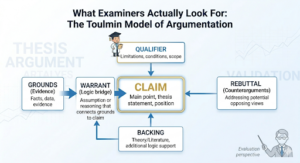
What Examiners Actually Look For: The Toulmin Model of Argumentation
The Toulmin Model of Argumentation was first proposed in 1958 by Stephen Toulmin and is still the benchmark for academic rhetoric and used by examiners of postgraduate dissertations. While examiners may not have a list of Toulmin in their heads, they evaluate dissertations on an unconscious basis using his framework. Students who fail to demonstrate each element clearly lose marks, regardless of how good their data is. Richard Andrews agrees that examiners are impressed by work that reflects argumentation and criticality, but postgraduate education never adequately trains students for argumentation. Below is an example of what examiners look for in any dissertation.
The Proposal: Your Argument’s Blueprint, not a Formality
Don’t start your dissertation proposal writing as a check box activity. It is the most significant document that you will use throughout your entire research experience. Rūstini et al. (2024) identified facts in higher education in 2018 from 27 students were found, and 22.22% of students had not attended a proposal seminar and had not completed a final assignment or thesis, 40.74% of students had attended a proposal seminar but had not completed a final assignment or thesis, and 37, 03% of students have attended proposal seminars and have completed their final assignments or theses. It is important as an issue to be researched because there is a difference between theory, expectation and reality in the field. This is where your argument comes from, where you create conceptual coherence, where you show examiners that you know what you are doing. If you get this wrong, the rest of your life becomes much more difficult. The image below shows how the proposal should be structured, and the same structure is followed by dissertation help UK to help students’ proposal and to build strong academic arguments.
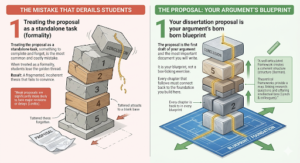
In Conceptual Frameworks, Jeanette Berman (2013) draws attention to the importance of having a clear and well-explained framework that helps to explain several different theories and provides a framework for the entire thesis. As Lynch et al. argue, theoretical frameworks provide a map for a study, linking research questions and offering intellectual bins for data analysis and presentation of findings. Below is the image that shows the mistakes that usually derail the students at proposal level.
The Literature Review: From Summary to Argument Authorisation
Many students don’t meet the marking criteria in their literature review. Andrews (2007) discovered that guidelines for post-graduate writing include ignoring or underemphasizing argumentation, so that students view the literature review as a summarizing exercise instead of constructing an argument. Examiners reward work that embodies criticality and analysis, yet many students remain stuck at the descriptive level. See below the stages of progression that every student must excel in.
If you see below, it is clear what a weak and strong writing is.
Examiners expect to see this progression. A reputable dissertation proposal writing service guides you through this progression, ensuring your literature review does not just report, it builds your case.
Methodological Alignment: Defending Your Argument’s Foundation
Your methodology isn’t simply a description of what you did. It’s about justifying why your research approach is the only logical way to answer your research question. This is referred to as methodological alignment. Crotty’s (1998) framework depicts the continuum that has to be intact. See below the sequence of methodology alignment.
If you have a break in this chain, the rest of your argument collapses. Examiners look for this alignment more than any other single element. If students cannot explain, even if they collected good data, they lose marks!

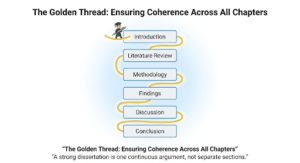
The Golden Thread: Ensuring Coherence Across All Chapters
The golden thread is a concept which is common to many doctoral supervision systems in the UK, including the Vitae Researcher Development Framework, as explained by Bray and Boon (2011). It outlines the main idea that you explain throughout your book, from your introduction to your conclusion, tying all chapters together. Logical development is more important than almost anything else to the examiner. If you see the thread and can follow it, your dissertation doesn’t feel like a series of loosely connected chapters. Below is the ideation of the golden thread that must be followed.
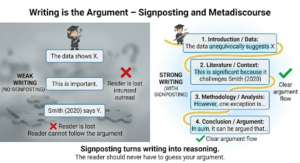
The writing is the argument: Signposting and Meta discourse
Nothing can impress examiners if you don’t write it well. In academic writing, clarity and precision, along with a logical flow of ideas, should lead readers through your reasoning. This is done by using signposting and meta discourse, the language used by writers to take the reader through their argument. Hyland and Tse (2004) has found that skilled academic writers use specific linguistic markers to make their reasoning explicit and easy to follow. Students’ inability to signpost effectively makes arguments difficult to follow and often makes it hard for the examiner to understand how ideas connect. Below is the image explaining how the meta discourse and signposting can be opted.
Why Expert Support Isn’t Optional: It’s Strategic
Even the best students find it difficult to write a dissertation, since it is a form of writing that is not taught explicitly in the coursework. So, students are often left to discover the rules of academic argumentation by themselves, and make avoidable mistakes and experience needless delays. The image below clearly articulates why you need an expert dissertation proposal writing service.
Conclusion
Data is only as good as the interpretations that are put into it. It is necessary to develop an argument around it. This is the basic rule that distinguishes the winning dissertations from those that are not accepted. The difference between a pass and a distinction is not how much data you’re able to gather. It is structure, coherence, and critical reasoning that distinguishes outstanding work from merely adequate submissions. Students who can make effective arguments, predict objections, and clearly and concisely lead the reader through their reasoning are rewarded by the examiner. If you are having the same issues, then your next step should be:
- Contact The Academic Papers UK for a free consultation to discuss your research challenges
- Receive a custom argument structure mapping tailored to your dissertation
- Submit with confidence, knowing your argument is built on a solid foundation
FAQs
1. What is the most common mistake students make in structuring their dissertation argument?
Treating each chapter as a standalone rather than part of a unified argument. This approach breaks the golden thread and results in fragmented arguments that fail to convince examiners.
2. How early should I start thinking about my argument structure?
During the proposal stage. This is when you establish your research question, theoretical lens, and methodological alignment.
3. Why do examiners care so much about my methodology section?
Because it demonstrates whether you understand what you are doing. When you cannot justify your choices, examiners question your entire research.
4. Can a dissertation proposal writing service help me if I’ve already started my research?
Yes. Professional guidance can help identify gaps in your argument structure, strengthen methodological alignment, and improve academic writing at any stage of your research journey using a dissertation proposal writing service.
You May Also Read : Turaska Explained: Meaning, Uses, Benefits, and Practical Strategies
Education
School Leadership Development in the Modern Education Era: Trends, Challenges, and Solutions

Introduction
The role played by the school’s leaders has drastically transformed over time. Leadership in the modern school system is not any more associated with classroom management, scheduling classes, or routine tasks. It encompasses motivating teachers, guiding students, dealing with changes, and establishing a conducive learning atmosphere for all concerned.
Now picture a scenario where a school principal enters a teachers’ meeting where the teaching staff is dealing with a lot of pressure due to the use of advanced technology while the students are facing emotional problems and the parents want individualized attention for their children. This shows that leadership cannot be confined merely to issuing directives.
The changing nature of this role has thus made it essential for school leaders to engage in developing their own competencies by taking up courses such as a School Leadership Course or even a school Leadership course online.
In this article, we shall focus on some of the important aspects regarding this issue.
Trends in School Leadership Development
Modern school leadership is being shaped by several important trends that reflect the changing needs of education.
Increased focus on digital learning and innovation
The use of technology has been integrated into educational settings today. School leaders are now supposed to assist teachers to integrate technology well in their teaching, so that the students benefit.
For instance, where the school leader adopts the use of online classrooms, there will be need for assistance from the same person to help the unskilled teachers cope with the technology.
Emphasis on student well being
Schools have realized that mental well-being is essential. School leaders have been trying to create a setting where pupils will feel safe and comfortable, both socially and academically.
For example, after recognizing that his/her pupils have become reserved following a stressful academic season, a school principal can initiate some wellness programs.
Shift toward collaborative leadership
Top down form of leadership is slowly taking its place with other styles of leadership where the leaders consult the teachers, parents, and the community in decision-making.
This implies that instead of coming up with plans to improve the curriculum by himself or herself, a school head decides to work together with the teachers in doing this.
Continuous learning for leaders
The concept of leadership development is not just about having a single experience anymore. School leaders learn continually through training courses, even the flexible option of taking an online school Leadership course.
Challenges in School Leadership Development
Despite these positive trends, school leaders face several real world challenges that make their roles more complex.
Managing diverse student needs
Students have different backgrounds and learning styles; it is therefore important to develop sensitive methods in addressing their diverse requirements.
As an illustration, a class may contain students requiring remedial teaching alongside those requiring advanced teaching techniques. It can therefore prove difficult in meeting the needs of all.
Teacher burnout and retention
Teachers can suffer from stress due to heavy workload and expectations. The leaders need to devise ways of supporting and retaining their employees.
An educational leader might note that the experienced teachers are suffering from exhaustion and think of implementing a flexible working schedule or an appreciation program.
Adapting to rapid technological changes
With the many benefits that come from technology, there is also an implication that schools will always be required to be flexible in their practices. This will be achieved by ensuring that all the teachers and pupils are ready to utilize the technology.
This may actually be seen in real life where a school suddenly adopts digital learning but the teachers are not able to conduct the classes effectively.
Building trust with parents and communities
With the many benefits that come from technology, there is also an implication that schools will always be required to be flexible in their practices. This will be achieved by ensuring that all the teachers and pupils are ready to utilize the technology.
This may actually be seen in real life where a school suddenly adopts digital learning but the teachers are not able to conduct the classes effectively.
Balancing multiple responsibilities
School leaders juggle administration, teaching quality, student welfare, and community expectations all at once. This can often feel overwhelming without proper systems and support.
Solutions for Effective School Leadership Development
To overcome these challenges, schools and leaders can adopt practical and meaningful solutions.
Investing in continuous leadership training
Attending a Leadership course at school aids leaders in gaining skills such as communicating, decision-making, and conflict management. The leadership programs offer practical experience which one may use in day-to-day situations.
School Leadership Course Online prove helpful for professionals who are quite busy due to their commitments.
Encouraging collaborative decision making
The management needs to consult the teaching faculty and other staff regarding any major issues. Apart from better decision making, this also fosters an element of ownership among employees.
For instance, when teachers participate in suggesting improvements for classrooms, it boosts their morale.
Strengthening emotional intelligence
Good leadership entails understanding the emotional well-being and requirements of the staff and students. By forging positive relationships, one is able to cultivate a healthy school environment.
Just the simple act of listening to your teacher or appreciating his/her contributions can make a great impact.
Promoting professional development for teachers
Leaders should provide opportunities for teachers to improve their skills. When teachers grow, the entire school benefits.
This could include workshops, mentorship programs, or peer learning sessions.
Creating a clear vision and direction
The vision will play a key role in bringing the entire group in the institution together towards a single aim. Vision communication will help in inspiring teachers as well as learners.
In this case, an institution that adopts inclusive education will have initiatives geared towards valuing all learners.
Building strong communication channels
Open and transparent communication with parents, teachers, and students helps build trust and reduces conflicts. Regular meetings and updates can make a big difference in maintaining relationships.
Conclusion
School leadership in the modern education era is both challenging and rewarding. Leaders are expected to adapt to change, support diverse needs, and create environments where everyone can thrive.
Although the process may be hard, there are ways to develop a great school leader who will inspire others. To achieve this objective, it is important to keep up with the trends, tackle issues effectively, and participate in lifelong learning such as taking a Leadership course at school or even an online school Leadership course.
Ultimately, being a great school leader is more than managing the school itself; it entails transforming the lives of individuals and preparing the way for the success of the students.
You May Also Read : Turaska Explained: Meaning, Uses, Benefits, and Practical Strategies

The Certified Management Accountant (US CMA) credential is one of the most prestigious and globally recognized certifications in management accounting and financial management. Awarded by the Institute of Management Accountants (IMA), the US CMA qualification is designed for students and professionals who want to build successful careers in corporate finance, management accounting, financial planning, business strategy, and performance management.
As organizations increasingly seek finance professionals who can contribute to strategic decision-making, the demand for US CMA-certified professionals continues to grow worldwide. Pursuing a US CMA Course can help students gain the practical knowledge, analytical skills, and professional credibility needed to excel in today’s competitive business environment.
At Synthesis Learning, students benefit from expert faculty, structured learning pathways, and exam-focused preparation designed to help them successfully complete the US CMA program and achieve their career goals.
Why Choose a US CMA Course?
The US CMA certification goes beyond traditional accounting education by focusing on financial management, business strategy, risk management, budgeting, forecasting, and performance analysis. The program prepares students to become strategic finance professionals capable of supporting organizational growth and profitability.
Unlike many accounting qualifications that focus primarily on compliance and reporting, the US CMA Course emphasizes business decision-making and management accounting, making it highly relevant for modern finance roles.
Benefits of Pursuing a US CMA Course
Globally Recognized Certification
The US CMA credential is recognized by multinational corporations, financial institutions, consulting firms, and global organizations. It demonstrates expertise in management accounting and financial leadership, enhancing professional credibility across industries.
Faster Career Progression
One of the biggest advantages of the US CMA qualification is its streamlined structure. Students can complete the certification in a shorter timeframe compared to many other professional finance qualifications, allowing them to enter the workforce and advance their careers more quickly.
Develop In-Demand Business Skills
The US CMA curriculum helps students develop expertise in:
- Financial Planning and Analysis
- Performance Management
- Strategic Financial Management
- Budgeting and Forecasting
- Cost Management
- Internal Controls
- Risk Management
- Decision Analysis
- Corporate Finance
These skills are highly valued by employers and directly applicable to real-world business challenges.
Improve Employability
Companies today are looking for finance professionals who can interpret data, drive business performance, and support strategic decision-making. A US CMA qualification demonstrates these capabilities and helps students stand out in a competitive job market.
Strong Salary Potential
US CMA-certified professionals are often rewarded with competitive compensation packages due to their specialized knowledge and ability to contribute to organizational growth and profitability.
Gain Practical Knowledge
The US CMA Course focuses on practical business applications rather than purely theoretical concepts. Students learn how to solve business problems, evaluate financial performance, manage costs, and make informed strategic decisions.
Flexible Learning for Students and Professionals
The US CMA program offers flexibility, making it suitable for students pursuing graduation as well as working professionals looking to upgrade their qualifications without interrupting their careers.
Career Opportunities After US CMA
A US CMA certification can open doors to a wide range of finance and management roles, including:
- Management Accountant
- Financial Analyst
- Cost Accountant
- Finance Manager
- Budget Analyst
- Corporate Controller
- Internal Auditor
- Business Analyst
- Financial Planning & Analysis (FP&A) Professional
- Chief Financial Officer (CFO)
The qualification is particularly valuable for individuals seeking leadership roles in finance and business management.
Why Study US CMA with Synthesis Learning?
Success in the US CMA examination requires expert guidance, disciplined preparation, and access to quality learning resources. Synthesis Learning provides students with a comprehensive learning ecosystem that includes:
- Experienced CMA faculty
- Concept-based learning approach
- Comprehensive study materials
- Exam-oriented preparation
- Mock tests and performance tracking
- Personalized mentoring
- Career guidance and professional development support
This structured approach helps students build confidence, improve exam performance, and develop practical finance skills that employers value.
Start Your US CMA Journey Today
The US CMA Course is an excellent choice for students and professionals who aspire to build rewarding careers in accounting, finance, and business leadership. With its global recognition, industry-relevant curriculum, and strong career prospects, the qualification provides a pathway to long-term professional success.
By choosing Synthesis Learning, students gain access to expert mentorship, quality education, and the support needed to achieve their US CMA certification and unlock exciting opportunities in the global finance industry.
You May Also Read : Soutaipasu Explained: Meaning, Uses, and Why It’s Gaining Attention
-

 Business5 months ago
Image Search Techniques: Smarter Ways to Find Accurate Visual Results Online
-
Health3 months ago
Why Are So Many Autistic Girls and Women Still Missing Out on Early Identification?
-

 Lifestyle7 months ago
Sustainable Ways to Buy and Sell Antiques
-

 Sports4 months ago
Ultimate Pragmatic Juara100.org Medal Achievement Guide for Maximum Rewards
-

 Health5 months ago
Pravi Celer: Benefits, Uses, and How to Add It to Your Daily Diet
-

 Technology4 months ago
TabooTube: What It Is, How It Works, and Whether It’s Worth Your Time
-

 Technology7 months ago
Top Features of ProgramGeeks Social You Didn’t Know About
-

 Education4 months ago
Soutaipasu Explained: Meaning, Uses, and Why It’s Gaining Attention